What is e-learning?
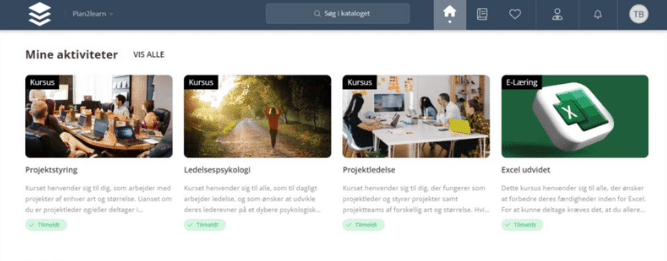
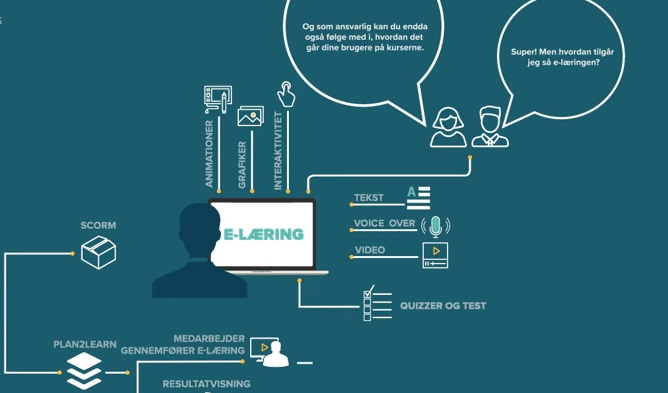
E-learning is electronic learning via computer, tablet, or smartphone. A course with e-learning could combine documents, images, videos, and/or quizzes that together form a comprehensive digital learning experience.
An e-learning course can be completed by employees on their own, regardless of where they are located, and is therefore an extremely practical tool for competency development. It is also a teaching tool that can create value in virtually all organisations across industries, as the only limits are the imagination when it comes to what kind of courses you want to offer.
An e-learning programme can revolve around onboarding Whether it’s new employees, training in the use of a tool, or something completely different, it’s entirely up to you.
Why should you use e-learning?
As humans, we get busier and busier, but at the same time we are more digital than ever before. Therefore, e-learning falls into a very dry place and is the The perfect teaching method for the modern employee. The biggest advantage of e-learning is therefore purely practical. Your employees can take the courses exactly when it fits into their schedule. As long as they have internet access, the learning is available regardless of where they are in the world.
Building and hosting e-learning courses is easier and cheaper than more traditional forms of instruction. This saves your organisation time and manual resources, which can be felt on the bottom line. Once an e-learning learning programme is built, there will be ample opportunity to reuse the material for new users, which is again a cost-saving measure.
A popular use of e-learning is in the onboarding of new employees. Here you can save a lot of manual resources by preparing a fully digital and automated e-learning programme. The new employee will receive the learning material and will be continuously trained for their new role, ensuring the best possible start in your company.
How do I get started?
The e-learning material must first of all be developed in-house or purchased from an external company. Of course, the material can be uploaded to internal systems, such as an intranet, but here you will not be able to see or extract relevant data. It is of great value to be able to see who has completed which courses and the like.
Therefore, it is a good idea to conduct e-learning through a learning management system (LMS), Where the teaching can be communicated to the users. With an LMS system you have the advantage of a greater overview of your employees’ progress in their educational course. You will be able to see how far they have reached in the course, their overall results, and follow up if there were any obstacles in their learning.
The subsequent evaluation is also made easier, as all the data is ready to be read. You can also extract the data into the format you want if it needs to be used for a presentation.
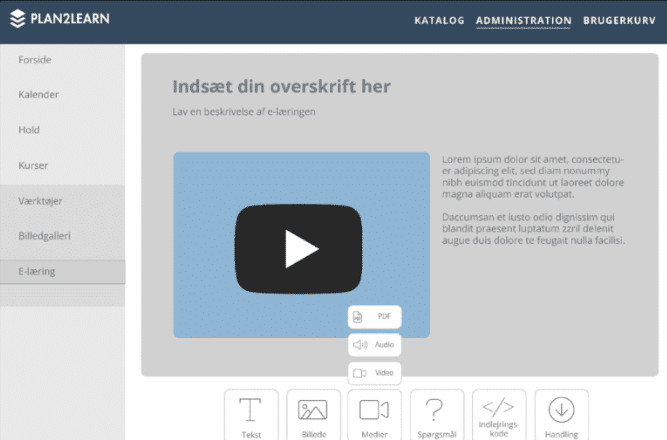
With plan2learn as the LMS system, it is easy to build e-learning courses. Here you also have the option to combine traditional classroom courses with e-learning for blended learning programme. In plan2learn you choose whether to use pre-made e-learning courses or your own material. Another option is to divide your courses into smaller pieces, better known as microlearning.
Types of e-learning
Microlearning is a unique approach to learning programme where the focus is on breaking up the teaching into smaller, easy-to-digest chunks, also popularly called learning nuggets. These nuggets could be small, individual pieces of information to be learned or activities to be performed.
Microlearning has all the same benefits as we described with e-learning, but with this form of teaching there is additional value to be gained. When the learning is easy to digest and not too time-consuming, it is easier for the user to find time to complete it. This could be during the lunch break or on the bus, where one can quickly complete a teaching session on a smartphone.
Blended learning is the combination of several learning methods in a single programme. It will most often involve a mix of e-learning and more traditional in-person instruction. Both forms of instruction have advantages, and when combined they create unique opportunities to build educational programs.
It could be a course that required practical experience with a physical tool in on site courses courses, while the theoretical part of the course was delivered as e-learning. In this way, there is balance and more flexibility in the teaching, which can also contribute to higher employee engagement.