What data do you actually have?
Before talking about what the data should be used for, it is worth being specific about what the system is actually about:
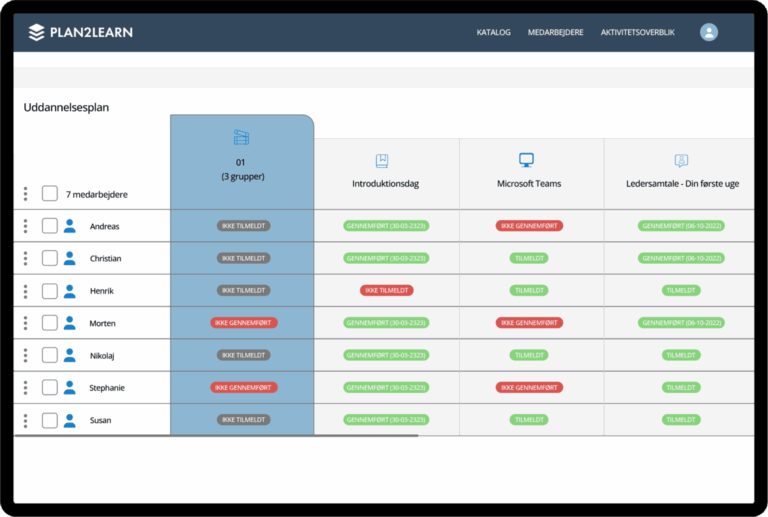
- Completed and ongoing activities per employee
- Competence profiles and which competencies are documented
- Certifications, and when the validity period expires
- Status of mandatory activities: enrolled, completed, or none of the parts
- Course evaluations and well-being measurements
If the data needs to be forwarded for management reporting or combined with data from other systems, we can use the Plan2learn platform to provide customized extracts, where you decide the content yourself and can repeat the extraction as often as you like.
Data finds the holes, so you can close them
The strongest use is the most unadventurous. The data shows what is missing.
With competency management Can you define the competencies a role requires and compare that with what employees have actually documented? The difference is the competency gap. That is the information that makes the next year’s training budget a decision instead of a repeat of last year.
Three holes are particularly worth looking out for:
- Certifications that expire. A certification that goes out the window while no one is watching becomes a staffing problem on the worst possible day.
- Competencies that exist only in one place. If one person is the only one with a specific competency in a department, that is a risk, not a strength.
- Mandatory training that has not been completed. Here the data are not for development; here they are for documentation.
Data is not a performance indicator but an input for development
A completion percentage tells you that someone has completed a programme. It does not tell you whether the person has become better at their work. Completion is an activity goal, not a result goal, and the two are surprisingly often mixed together in dashboards.
Therefore, use learning data as input for the conversation about performance, not as a summary. They answer “what have we invested in and what is lacking”, not “who is the best”. If you want to read more about the discipline itself, we have a guide to performance management.
Three ways to use the overview for talent development
1. The leader arrives prepared for MUS
Most development conversations start with both parties trying to remember what happened last year. Our platform has an inbuilt leadership module, so the manager can see the employee’s completed and ongoing activities, documented competencies, and expiring certifications before the conversation begins.
It moves the conversation from memory to agreements. And it makes it significantly easier to follow up at the next conversation.
2. Find the skills you already have
When a position needs to be filled, the first question is rarely whether someone could take it internally. It is difficult to answer that if the answer lies in the heads of twelve leaders.
A comprehensive overview of competencies makes internal mobility something that can be examined, instead of something that is discovered by chance. Midt- og Vestsjællands Hospital is using a dashboard of employees’ competency levels to support recruitment, onboarding, and development conversations.
3. Plan according to roles, not according to individuals
When competency requirements are linked to roles rather than individuals, you can see what it takes to move an employee from one role to the next. This is the concrete version of a career path, and it is easier to talk about than good intentions.
If you use the target group function in the platform, the learning for the new role can even be assigned automatically when the employee changes.
Data that strengthens the management
A dashboard that has no actions taken is a report with better graphics.
Gallup finds, That leaders account for 70 percent of the variation in team engagement, and that employees with highly engaged leaders are 59 percent more likely to be engaged themselves. If the data don’t reach the person having the conversation with the employee, nothing happens.
Therefore, it is crucial that the manager sees his own employees and not the entire the organisation. An overview of 4,000 employees is useless. An overview of the 14 people he/she is leading becomes useful.
The boundary between development and control
Most people skip this section. Don't do that.
The moment learning data is used to control employees’ behavior rather than support their development, it becomes a control measure in the sense of personal data legislation. The Data Protection Authority's guidance on the control of employees states that the processing can only take place if the overall conditions of legality and proportionality are met, and that employees must be informed at the latest at the time when the control measure is initiated.
Of particular note: if information collected for one purpose is later to be used for control purposes, the employee must be informed of the new purpose in advance.
In practice, this means two things. Be clear to employees about what the data is being used for. And don't create reports that you wouldn't be able to explain at a staff meeting.
Three questions to start with
You don't need a data analyst to get started. You need three answers:
- What decision should this overview help to make?
- Who should see it and what should they do about it?
- Could we explain the purpose of the employees whose data the data is about?
If you cannot answer the first question, the report should not be built yet. If you cannot answer the third question, it should not even be built.
Book a demo, Then we look at which overviews make sense in your organisation and who should have access to them.