The labor market is not waiting for anyone.
It is a necessity for individual employees to develop their skills within their field, both to improve their competence profile in the labor market, but also for personal interest. In fact, the opportunity to learn and develop their competencies is the The biggest factor when choosing a workplace.
This applies not only to the general employee, as the desire to sharpen their skills also calls on managers. In fact, it is Every fifth leader is starting to look for a new job, Where development opportunities are better. Therefore, you should ensure that your organisation has good development opportunities if you want to retain your most important resources – the employees.
Employee development falls back on management
It cannot only be the employee’s responsibility to develop themselves on their own. As a leader in an organisation, you must see your employees’ development as an investment that will provide value in the long run. Just as you update systems and tools in the workplace, you must keep employee competencies up to date with courses and training programs.
Therefore, the immediate manager should have an overview of each employee, and who could benefit from development in relevant competencies. You can also offer development opportunities in competencies that may be slightly outside the employee’s area of responsibility, but could be relevant in the future. However, this is a decision where you must be confident in your case before implementing it in practice. If the employee develops in a discipline that cannot be applied within the the organisation, they will most likely be dissatisfied, or even worse, leave your organisation.
On the other hand, an employee who spends time and energy developing within a valuable discipline will greatly value the personal value of being able to contribute with their newly acquired competencies. At the same time, your organisation will benefit from a new set of competencies in its toolkit.

How to get started
Identify competence needs: You should start by identifying your employees’ current competencies and evaluating their performance within their area of responsibility. This will help you identify areas where there is room for development and improvement. You should also ask your employees if there are areas where they have a personal interest in becoming better.
Set goals: You should plan both short-term and long-term goals for employee development. These should preferably be measurable, as this will help you assess whether the efforts have been successful. Of course, it will also benefit you if the goals align with the organization’s strategy.
Develop a strategy: Sit down and create a plan for the various interventions you will use to help your employee achieve their goals. This could be anything from longer training courses, seminars, or some form of mentoring program.
Communication: Let your employees know that you are committed to their development and wellbeing-being in the workplace. Involve them in your planning and let them provide input on how to best achieve this development goal. You should also regularly follow up with the employee during the process itself, as this will allow you to adapt your efforts to best suit their needs.
Evaluate and measure results: After the development process has concluded, you should evaluate the results of the effort. Here, you can benefit from again incorporating employee feedback on the process, as their experience of the effort plays a major role. Subsequently, you should conduct performance measurements to assess whether the employee has developed within the specific competency.
Adjust your bets: Once you have evaluated your results, you can better adapt the process in the future. This way, you ensure that your employee development improves continuously. You should view your employee development as a long-term investment, and therefore you should always work on making it better.
Employee development automated with an LMS
A structured and well-thought-out employee development process can be a demanding process. Therefore, there can be great value to be gained if you manage your control of employees’ competencies through a learning management system.
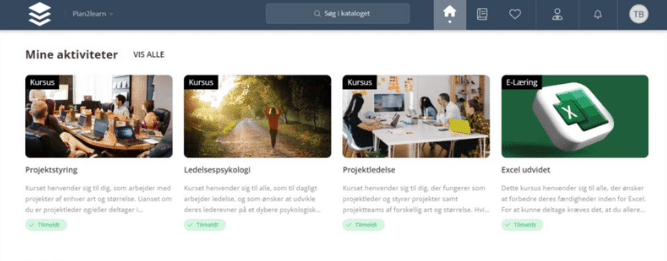
Here you will always have a structured overview of each employee, their current competency profile, and which training courses they are currently undertaking. From here you can also easily arrange new course programs for the right employees and enroll them as needed. This eliminates a large part of the manual, administrative work for the individual manager.
With a simple overview of the competencies in your organisation, you will always be able to perform strategically. competency development. You can quickly identify departments with development potential and ensure that there are no gaps in competency within your organisation.