Hvidovre Hospital digitalizes its first aid dummies
Hvidovre Hospital needed to make the mandatory courses in cardiac-resuscitation easier to implement and administer. Previously, an instructor had to assess the exercises on the manikin and completed courses were recorded manually. It could take 3–6 months before the competence was evident from the employee’s profile. With Plan2learn, the manikins are connected to the learning platform, so completed courses are registered immediately.
About the customer:
Hvidovre Hospital requires that all employees complete a course in cardiac resuscitation as part of their induction and renew their competence every two years. This applies to both healthcare professionals and employees in other functions, such as the cafeteria.
How Plan2learn created value
Automatic recording of competencies
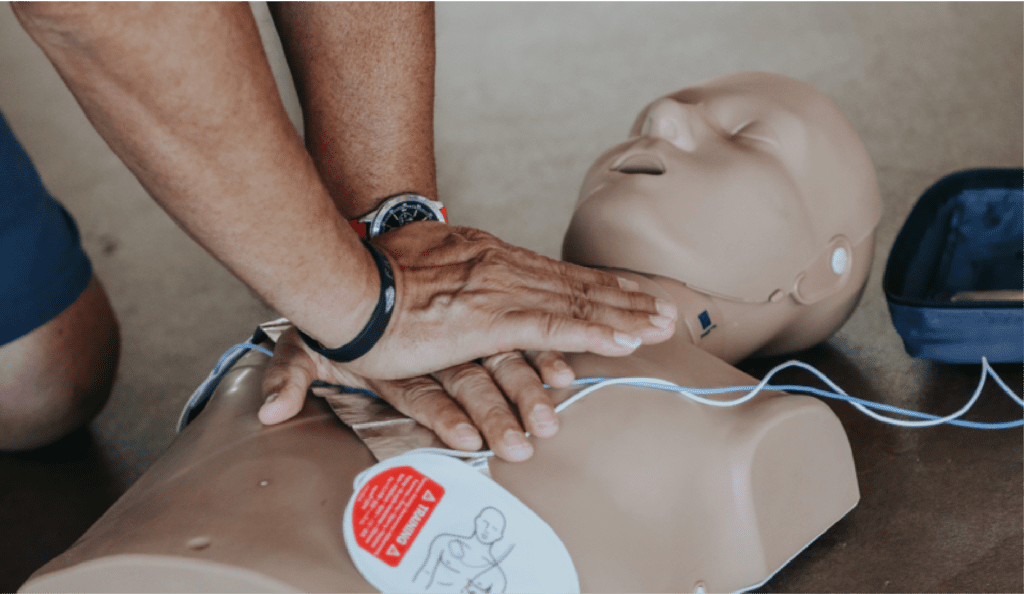
The first aid dummies are connected to Plan2learn. The competence is registered as soon as the employee has completed the CPR training.
Training when it suits
Employees take the course when they have time. It does not require an instructor or a room to be booked.
Objective documentation
The dolls automatically and in the same way assess whether competence has been achieved for everyone. This provides documentation the hospital can rely on.
Hidden potential for digitalization and greater efficiency
Hvidovre Hospital has long used Plan2learn for the competency development of employees’ competencies. The system provides managers with a comprehensive overview and makes the training process simple for the employees. But a new project has created an innovative connection between practical exercises and the Region’s digital learning portal.
The staff at Hvidovre Hospital undergo a mandatory CPR (cardiac and pulmonary resuscitation) course as part of their induction training. This competency must be renewed with a 2-year interval, and involves practical exercises on a resuscitation dummy.
“
At our hospital, we have made it mandatory for all employees to undergo a cardiac resuscitation course, and this applies to everything from nurses to the staff in the cafeteria. It is essential that everyone knows how to react and how to work together in such a situation.
Jesper Friis-Hansen, anaesthetic nurse and consultant at Hvidovre Hospital
Previously, an instructor had to be present to assess whether the employee had passed. The instructor would then manually record this in plan2learn later.
”Before, an employee had to enter their personal information before the course, and after they had completed the course, the data was sent on to the relevant employees. They then had to enter that data into the system, and it could take up to 3-6 months before it was recorded and displayed on the employee’s profile. This created great frustration, as the employee could be pressured into taking the course, despite it already having been completed” Explains Merete Rosendal, specialist in the department for HR, occupational health and education.
Therefore, the employees agreed to find a better solution and set down a series of requirements that the new system had to meet. Among these were the desire for the competencies to be recorded in the system as soon as the course was completed.
Integration creates flexibility and saves resources
After a long collaboration with plan2learn, an integration has now been created between the learning platform and the dummies that employees use for their training.
“
We have converted our old face-to-face courses to e-learning, and there was a lot of work involved in transferring all our existing data into the system. But now it just works, and a full integration has been created between plan2learn and our cardiac mannequins.
Jesper Friis-Hansen, anaesthetic nurse and consultant at Hvidovre Hospital
This means that the hospital staff can now take their CPR course exactly when it suits them. An instructor is no longer necessary. The rescue doll automatically talks to plan2learn and assesses itself when an employee has met the requirements to pass the course. It then updates the employee’s competency profile, so the course is now registered as passed.
“
Now the competence is created in the system as soon as an employee completes the course on the doll. This provides much greater efficiency and saves us a lot of resources, as we don’t need instructors or rent premises for a large course. The employees can simply take the course exactly when they have time. This could be during a night shift or a quiet moment during the workday.
Jesper Friis-Hansen, anaesthetic nurse and consultant at Hvidovre Hospital
More digitalization is planned in the future
The new integration therefore creates greater freedom for employees regarding when and where they will take their CPR course. Plan2learn also ensures that employees are called back when their skills need to be refreshed.
“
”A major advantage is also that the system always provides us with an objective assessment. We can immediately see what each individual employee has in terms of competencies in a given field. If we are asked whether we possess the competencies in a specific field, we can present a specific percentage of employees who have documentation of this.”
Jesper Friis-Hansen, anaesthetic nurse and consultant at Hvidovre Hospital
This digitalization has sparked thoughts in the employees, because a greater degree of automation could create great value across their training and teaching.
“
In the long run, we have other equipment that could be set up with the same automation. We know the process of setting it up now, and more automation in our training provides greater flexibility for our employees. We are currently exploring workflows where it could make sense. This could, for example, be in the relocation of patients, where portering could be offered the same training opportunity
Jesper Friis-Hansen, anaesthetic nurse and consultant at Hvidovre Hospital
Would you like to book a call?
Daniel Jakobsen
Head of Sales and Implementation